A Garden You Can Feel
Sensory gardens for people who are blind or partially sighted
A sensory garden is not a flower bed that happens to smell nice. It is a patch of outdoor ground planned so that scent, texture, sound and taste do the work that colour usually does. You are meant to brush the leaves, crush a herb, listen for water, and find your way by the edge of the path.
Most gardens are laid out for looking. That leaves a person with sight loss standing beside the view while someone else describes it. A sensory garden changes the invitation: come in and use the place yourself.
Why plant one if someone in the family is blind?
Because the garden stops being a picture other people look at, and becomes a room the whole household can share.
For the person who is blind or partially sighted, a small, well-planned patch offers landmarks they can find again: the rosemary at the corner of the path, the fountain that gives a bearing, the velvet of lamb’s ear at hand height. Independence outdoors is often less about a big landscape than about knowing what is within reach and where the path goes.
For family members who can see, the same plants are a way to spend time together without turning every outing into a guided tour. You can pick chives for supper, compare two kinds of bark, or sit where the lavender throws its scent, and nobody has to narrate the view. Children, partners and visiting relatives get something to do with their hands. The garden becomes a shared habit, not a favour.
You do not need a large property. One raised trough beside a chair — rosemary, lavender, chives and lamb’s ear — with a firm path from the back door, is already a sensory garden.
How to set one out
Give the garden a path you can follow. A loop is better than a dead end. Keep the surface firm and even, and give it a clear edge — a kerb, a change of material, or a rail — so a cane or a foot can find the boundary. Cut back branches at face height. In a larger garden, take the path through the plants, not past them.
Raise plants to the hands. A trough or raised bed brings scent to the nose and leaves to the fingers without kneeling. Put a sturdy seat where the smell is strongest. If someone in the house has some remaining sight, use strong contrast: pale gravel against a dark edge, white flowers against dark leaves, planting in blocks rather than speckles.
Add one reliable sound — a small bubbling bowl is enough — so the garden has a landmark you can hear. Label plants in large print, and in Braille if that is used at home. Keep thorns out of the path, and do not put poisonous plants where a guest might pick a leaf to taste.
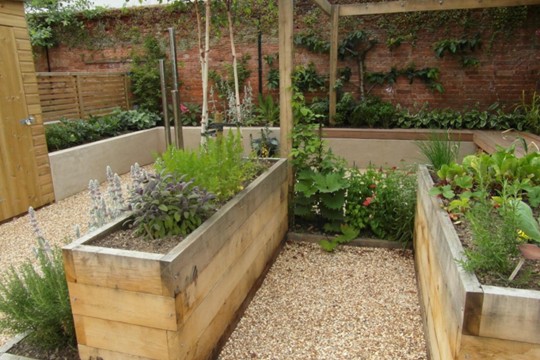
Why this photograph is here: it is not a famous named garden. It shows the home-garden idea in one picture — raised beds at hand height and a firm path with a clear edge. That is the layout that makes a sensory patch usable when you cannot rely on sight.
Plants that work hard
Choose plants that do two jobs, and that you are allowed to touch.
- Smell: lavender; rosemary and thyme; scented pelargoniums (many are South African — the scent is in the leaf); buchu; wild rosemary; wild garlic; mint in a pot.
- Touch: lamb’s ear; spekboom and smooth succulents; grasses and Cape restios; woolly thyme along the path edge.
- Sound: grasses and restios in a breeze; a small water feature; seed heads left to rattle.
- Taste: chives, parsley, basil, nasturtium, strawberries at the front of a trough. Only taste what you planted on purpose.

Why this photograph is here: lamb’s ear is the plant people remember with their fingers — thick, silver, velvet leaves. It is a working example of a tactile plant, not a picture of a public garden
Gardens you can visit in South Africa
A few public places in this country have made space for the non-visual senses. They are not all the same thing. Some were built for people with sight loss. Others are pleasant scented or educational gardens that sit next to the idea. Check hours and fees before you go.
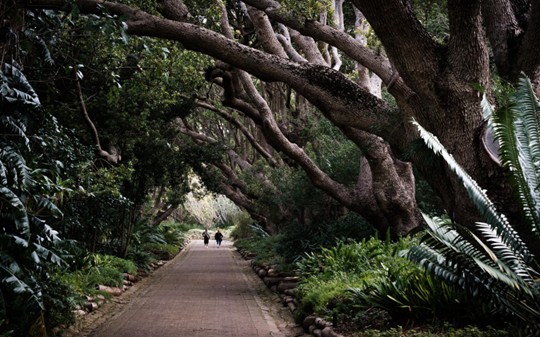
Kirstenbosch National Botanical Garden, Cape Town. This photograph shows a broad, edged path under old trees — the kind of clear route that helps a visitor keep their bearings. It is the garden itself, not a close-up of the Braille Trail
Kirstenbosch, Cape Town — a proper offering for visitors with sight loss. The Fragrance Garden is planted for scent and unusual textures. From there the Forest Braille Trail runs about 450 metres through indigenous forest and a small wetland. A guide rope marks the route. Blocks on the rope signal stopping points. Signs are in large print and Braille. There are benches and a fountain. This is a public SANBI garden with an entrance fee (pensioners are often free on Tuesdays). The Braille Trail is uneven in places; many visitors with sight loss use it with a companion. The Fragrance Garden on the lower ground is the gentler start. sanbi.org
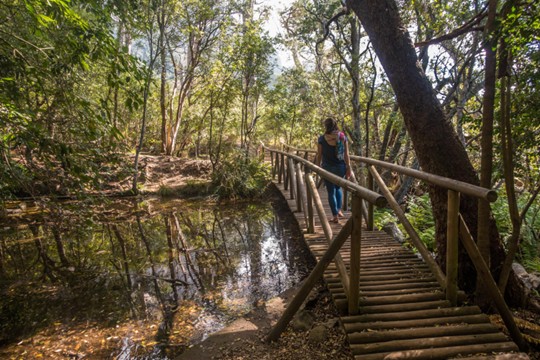
Also Kirstenbosch: a wooden boardwalk through forest and water. Boardwalks keep the feet off roots and wet ground, and the rail gives the hand something to follow. This is the character of the forest trail, even though the picture is not labelled as the Braille Trail itself.
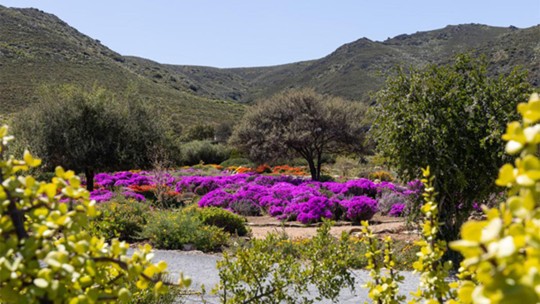
Karoo Desert National Botanical Garden, Worcester. The photograph is of the public garden landscape — arid planting against the hills — not a close-up of the Braille Trail boards. The trail sits inside this garden
Karoo Desert National Botanical Garden, Worcester — a purpose-built sensory trail for people who are blind or partially sighted. Opened in 2022 and designed with Worcester’s Pioneer School for the Visually Impaired. The 154-metre loop has raised beds of fragrant and textured arid plants, a brick kerb and tactile paving, large print, Braille, and QR codes that open audio. This is the closest thing in South Africa to a dedicated public sensory garden for sight loss. Public SANBI garden, about 120 km from Cape Town, with an entrance fee. Worth the trip if you can make it.
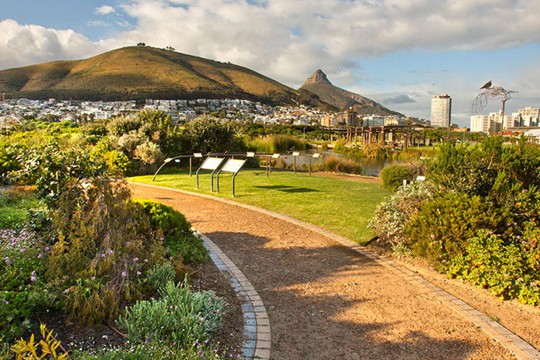
Green Point Urban Park, Cape Town. A free public park. The photograph shows the Biodiversity Showcase Garden — a planted path with Cape flora — which sits beside, rather than being, a garden designed only for sight loss
Green Point Urban Park, Cape Town — adjacent, and free. The Experiential Education Garden was laid out so visitors can touch, smell, taste, listen and look. It is a public sensory-style space, aimed largely at families and school groups, not a Braille garden. Still useful if you live in the city and want a scented, textured walk without a ticket. Open daily; check City of Cape Town hours.
We have not listed every botanical garden in the country. A beautiful public garden is not automatically a sensory garden. If a venue only offers a pretty view, it does not meet the test. Ask at the gate: is there a fragrance garden, a Braille trail, raised planting you may touch, and signs you can read with your fingers or hear?
A note on the photographs
The pictures in this piece do two different jobs. The raised beds and the lamb’s ear show features you can copy at home. The Kirstenbosch, Worcester and Green Point photographs show the public places named above, so a sighted family member can see the setting. They are not all close-ups of Braille signs or touch-beds, because those details are small and change with the season. Read the caption under each picture: it says whether you are looking at a purpose-built trail for sight loss, or at the wider garden around it.
Start this weekend
Put a firm path to a chair. Plant one trough you are allowed to handle. Add a sound you can find again. That is enough. The rest of the garden can grow around a person who already knows where the rosemary is.