Out of Sight, Still Out of Time
February is the shortest month of the year—just 28 days, or 29 in a leap year. For people living with rare retinal diseases, even that brief window of awareness is often not enough.
Rare retinal conditions are frequently progressive, genetic, and life-altering. Many begin in childhood or adolescence and lead to severe vision loss or blindness. In South Africa, their impact is often intensified by socioeconomic factors such as poverty, limited access to specialist care, high UV exposure, and nutritional deficiencies.
Consider Reena, a 13-year-old from Soweto living with Retinitis Pigmentosa. As daylight fades, so does her vision. Night blindness was her first symptom, followed by gradual peripheral vision loss—a pattern typical of this inherited condition. Or Jabulani, born deaf due to Usher Syndrome, who began losing his sight in early adulthood as the same genetic condition affected both his hearing and vision.
Conditions such as Stargardt disease, which affects central vision, often emerge in children and teenagers—just as independence, education, and social connection become most important. While Stargardt disease is considered rare globally, Retina South Africa sees suspected cases with alarming regularity in under-resourced communities.
The harsh reality is that approximately 95% of rare retinal diseases currently have no effective treatment. Breakthroughs like Luxturna, a gene therapy for a specific inherited retinal condition, have shown what is possible—but at costs far beyond the reach of most South Africans.
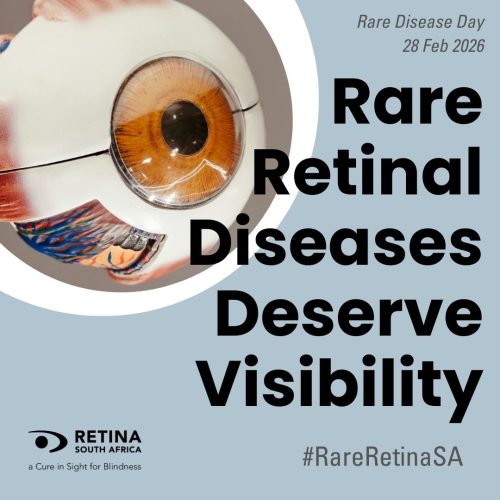
Rare Disease Day, first observed internationally in 2005, is marked in February to draw attention to conditions that are too often overlooked. For Retina South Africa, this is more than a symbolic date. It is a call to action.
We advocate for:
- Improved data collection and case mapping across South Africa
- Access to diagnostic tools, such as OCT imaging, in rural and public healthcare settings
- Training for healthcare workers to recognise early warning signs of retinal disease
- Increased research funding and policy attention for rare eye conditions
February 29—when it appears—is not a novelty. For the rare disease community, it represents visibility, urgency, and hope.
We encourage clinicians, patients, and families to share anonymised fundus images, raise awareness on social media using #RareRetinaSA, and support advocacy efforts that ensure rare retinal conditions are seen, counted, and addressed.
Because out of sight should never mean out of mind.
More Articles
Article title: Lighting for Sight .
UNDERSTANDING LED LIGHTS AND EYE HEALTH LED lights emit blue light, which has been linked to potential eye health.
Article title: Gene Therapy – The Future .
Dr Jannis Paulus of the Wilmer Eye Institute (Johns Hopkins) shared the latest advances in stem cell research with.
Article title: Retinal Realities Podcast – Episode 11 – Women with Vision – with Dr Farah Moti .
World Patient Safety Day - 17 September 2023 - Alert: Protect Your Vision - While online media can lead.