Hope is on the Horizon
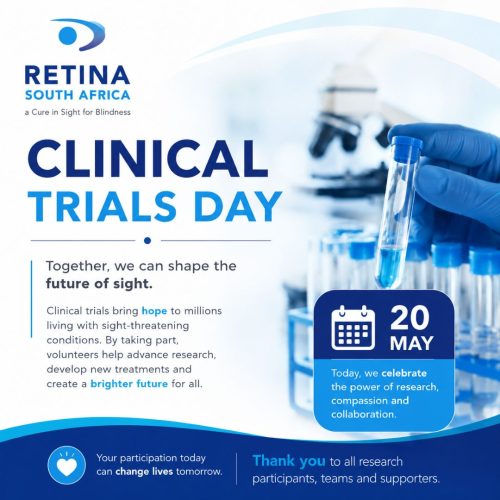
International Clinical Trials Day | 20 May 2026
On International Clinical Trials Day, Retina South Africa joins the global healthcare community in recognising the critical role clinical research plays in advancing medical science—and changing lives.
For people living with genetic retinal conditions, the future is no longer defined only by vision loss. Today, thanks to clinical trials, there is real and growing hope for preserving—and even restoring—sight.
Why Clinical Trials Matter
Clinical Trials Day commemorates 20 May 1747, when one of the first controlled medical experiments took place. Nearly three centuries later, clinical trials remain the foundation of medical progress.
They are essential to:
- Ensure treatments are safe before reaching the public
- Prove that new therapies are effective
- Protect participants through strict ethical standards
Clinical trials are not experimental in a risky sense—they are carefully regulated, ethical, and essential for turning scientific discoveries into real-world treatments.
A New Era for Genetic Eye Conditions
For individuals affected by conditions such as:
vision loss has long been considered inevitable. These inherited conditions gradually damage the retina, often leading to partial or total blindness.
But that reality is changing.
Advances in genetics and biomedical research are opening up entirely new possibilities, including:
- Gene therapies that replace faulty genes responsible for vision loss
- RNA-based treatments that can repair or modify genetic mutations
- Medications designed to slow disease progression
- Innovative approaches that help the retina bypass damaged cells
Several treatments have already been approved internationally, and many more are in advanced stages of clinical trials.
What was once a distant hope is now becoming a reality.
Bridging Science and Real Lives
“Clinical trials are the bridge between scientific discovery and real-world treatment,” says Claudette Medefindt, Head of Science at Retina South Africa.
“Without clinical trials, today’s breakthroughs in genetic eye disease would simply not exist.”
Retina South Africa has already played a role in global research efforts, including participation in a clinical trial aimed at slowing vision loss in Stargardt disease—a condition that affects approximately one in 10,000 South African children.
Challenges in South Africa
Despite the progress, significant barriers remain.
More than 300 gene mutations are linked to inherited vision loss, and most treatments are gene-specific. Accurate diagnosis is therefore crucial—but access to genetic testing in South Africa is still limited.
Currently:
- Genetic diagnosis is not widely available in state hospitals
- Medical aids often do not cover genetic testing
This creates a gap between scientific progress and patient access.
“With more support from funders and those affected, we could bring more trials and imminent treatments to South Africa,” Medefindt adds
Investing in a Future with Sight
The future of treatment for genetic retinal conditions is no longer hypothetical—it is actively unfolding.
For many, especially young children, early intervention through clinical trials could mean the difference between losing vision and preserving it.
“We have young children who could have vision loss stopped right now with enough support,” Medefindt concludes.
Be Part of the Change
Clinical trials are transforming what is possible—but progress depends on awareness, participation and support.
By investing in research and expanding access, we can help ensure that life-changing treatments reach everyone who needs them
Read the full press release PRESS RELEASE Clinical Trials Day 20 May 2026
More Articles
Article title: Charles Bonnet Syndrome .
COVID Has had many effects that were unexpected, and it actually highlighted issues that lurked in the background for.
Article title: Still Riding Strong at 81 .
At 81 years old, Brian Garvey is proof that passion has no age limit. His sporting journey has been.
Article title: Annual General Meeting .
Retina SA are grateful to Bayer SA for hosting our Annual General Meeting on Saturday 12 August 2023. Their.