
































































Tailoring Your CV
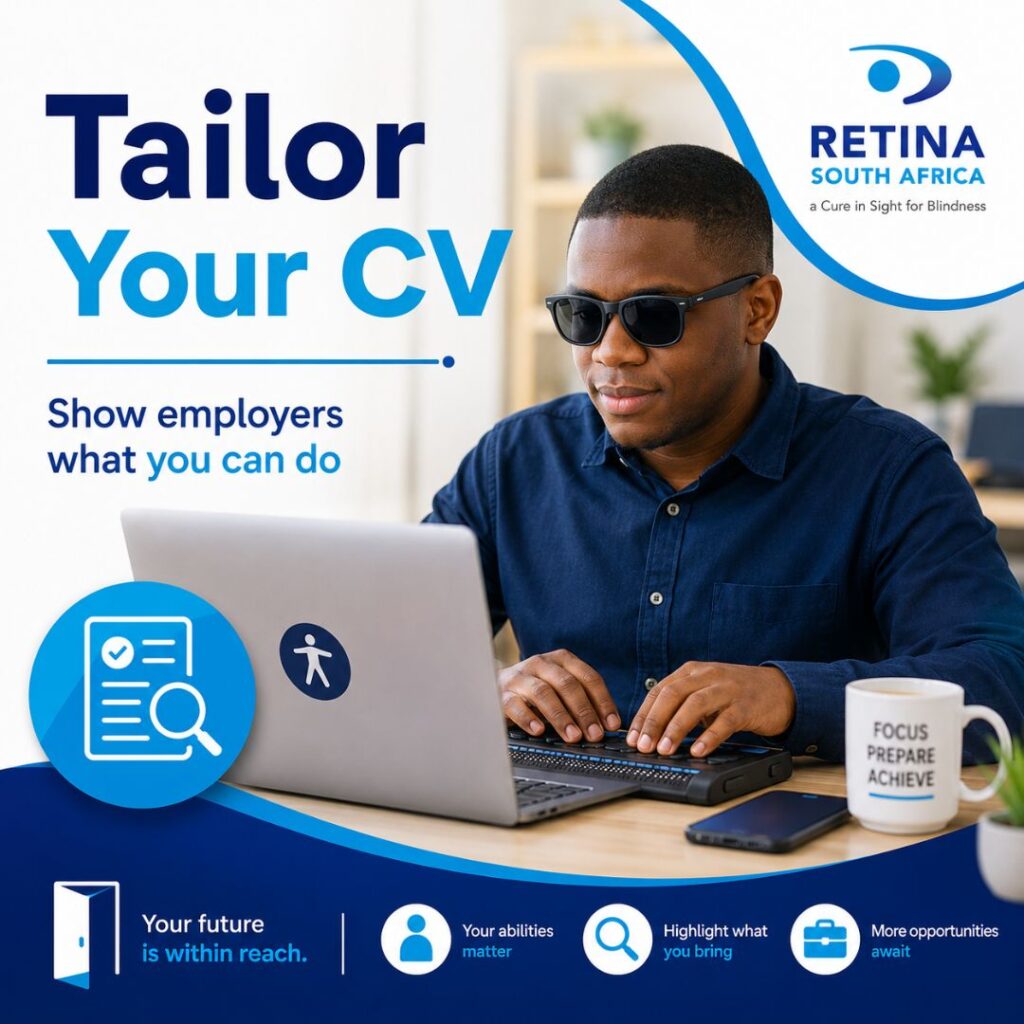
Tailoring Your CV
When you are job-seeking as a person with a disability or visual impairment, your CV is often the first (and sometimes only) impression an employer gets of you. Many people make the mistake of creating one single CV and sending it to every vacancy they see. This “spray and pray” approach might occasionally lead to an interview, but the chances are very low; especially when you are already facing extra barriers in the job market.
A strong CV is not a one-time document. It must be reviewed and adjusted for every single job you apply for. Employers spend only a few seconds scanning each CV. If yours does not clearly show that you match what they are looking for, it will be passed over. Tailoring your CV greatly improves your chances of getting noticed and invited for an interview.
Why you should never send the same CV to every job
- Job descriptions differ, even when the role title is similar.
- Employers use keywords from the job advert to search CVs (especially through Applicant Tracking Systems).
- A generic CV fails to highlight the exact skills and experience the employer needs right now.
- When you have a disability or visual impairment, you want the focus to stay on your abilities and achievements, not on a standard template that does not speak directly to the job.
How to tailor your CV effectively: a practical step-by-step guide
Read the job description carefully
Print or open the advert and highlight the key requirements, duties, and “essential” or “desirable” skills. Note any specific software, tools, or experience mentioned.
Create a master CV (your personal bank of information)
Keep one detailed document that contains all your experience, education, skills, and achievements. Never send this version. Use it only as a starting point.
Make a new copy for each application
Save it with a clear name, for example:
YourName_CV_JobTitle_Company_June2026.docx
Adapt the most important sections
Professional Summary / Profile (top of the CV):
Rewrite 3 to 4 lines so they directly address the main needs of the job. Mention relevant strengths first.
Work Experience:
Put the most relevant jobs higher. For each role, emphasise achievements that match the job description. Use numbers when possible (e.g., “Supported 25 customers daily”, “Improved data accuracy by 30%”).
Skills section:
Move the skills the employer wants to the top and use the exact words from the advert where appropriate.
Irrelevant information:
Remove or shorten parts that do not relate to this specific vacancy.
Use clear, accessible formatting (especially important for visual impairment)
- Use a simple, sans-serif font (Arial or Calibri, 11 to 12 pt).
- Keep plenty of white space.
- Use clear headings (Heading 1, Heading 2) so screen readers can navigate easily.
- Avoid complex tables, columns, or text boxes if possible.
- Save the final version as both a .docx (for editing) and a clean PDF (for sending). Test the PDF with a screen reader if you use one.
Do not mention your disability or visual impairment on the CV unless:
- The job specifically asks for it, or
- You need to explain a career gap related to your disability. Focus on what you can do. You can discuss reasonable adjustments later, once you have an interview.
Proofread and get a second opinion
Read it aloud or use text-to-speech. Ask a trusted friend, mentor, or careers advisor to check it. Small spelling or formatting errors can make your application look less professional.
Final tip
Tailoring your CV takes extra time, usually 30 to 60 minutes per application, but it is time well spent. Instead of sending 20 generic CVs and getting almost no replies, you can send 5 to 8 well-targeted applications and see much better results.
A carefully prepared CV shows employers that you are serious, organised, and genuinely interested in their role. That message is especially powerful when you are a person with a disability or visual impairment demonstrating your capability and professionalism from the very first document.
Next week’s article in this series will look at how to write a strong covering letter that works together with your tailored CV.
More Articles
Article title: National Management Committee .
Retina South Africa is pleased to introduce the newly elected MC: Chairman: Manny Moodley, Attorney, from Cape Town. Vice- Chair: Anton.
Article title: Lighting for Sight .
UNDERSTANDING LED LIGHTS AND EYE HEALTH LED lights emit blue light, which has been linked to potential eye health.
Article title: Living with Stargardt’s Disease: Strength, Sport, and Community .
Rare Disease Week is a time to recognise the resilience, courage, and lived realities of people navigating conditions that.